
Since the advent of reverse osmosis technology, the consumer cost has dropped significantly and the equipment has become more widely available. The users of the equipment of can be divided into two main categories: water users and water consumers. Water users use water for their process, whether it is manufacturing, medical testing, or steam. Water consumers use water as drinking water. Focusing on the consumption of water, there are health considerations associated with the consumption of reverse osmosis (RO) water as well as global ethical considerations for the production and distribution of clean drinking water.
Health Considerations
A reverse osmosis system is very effective at removing contaminants from the water to provide pure water to the end user. There are many contaminants that are found in water, no matter what the source is, that are harmful to human health. Reverse osmosis and its pretreatment can remove harmful ions, metals, organic chemicals, pesticides, and radionuclides. Public water suppliers in the United States are required to test the water supply to ensure that it conforms the to the federal water standards.
Despite the requirements of the federal safe drinking water act, the water still contains some chemicals that are harmful to human health. Chlorine and Chloramine are added to the water to prevent the growth of microbes that could seriously harm the health of the public. These chemicals are effective in maintaining the water free of microbial contaminants as it travels from the source to the point of use. However, the long-term consumption of Chlorine and Chloramine can be detrimental to people’s health.
Water consumers, of both public water and well water, are taking water treatment into their own hands to ensure that their water quality is very high by using a home reverse osmosis water treatment system. The carbon pre-filter for a reverse osmosis system will remove both Chlorine, Chloramine, and other chemicals. The reverse osmosis membranes prevent the other contaminants from passing through which results in very pure water. The removal of water contaminants eliminates water as the source of health problems.
A reverse osmosis system is not the perfect solution to all issues in regard to drinking water. It is recommended that a typical RO system should have had some pretreatment to the water prior to it being fed into the system. “RO systems can remove microorganism, however, it is not recommended for that use (i.e., only coliform-free water should be fed to the system) because membrane deterioration can occur due to the bacteria, and contamination may occur through pinhole leaks” (University of Nebraska, n.d.).
According to Dr. Jacqueline Gerhart (2011), reverse osmosis systems remove the good with the bad. Beneficial minerals in the water are removed, which is not an issue with a well-rounded diet. When deciding on using a reverse osmosis system, including a diet that is rich in minerals should come along with it. Otherwise, according to the World Health Organization’s report Chapter 12. Health Risks From Drinking Demineralised Water (n.d.), people could be putting themselves at risk for cardiovascular disease, gastrointestinal issues, and bone density deficiency.
Reverse osmosis systems remove minerals, however, there may have been very low levels of minerals in the water to start with. Jim McMahon (2013) suggests that drinking water with a low level of minerals is not much better than drinking water without minerals. He makes the point that water with contaminants is substantially worse for the human body than the low level of minerals will benefit the body. A mineral supplement can be taken to help to counteract the deficiencies of the RO water.
Lastly, when water goes through the reverse osmosis process and has the antimicrobial chemicals removed, it is important to use the water at the point in the needed volume. Because the water is devoid of antimicrobials, it can create an environment where harmful microbes can flourish. If the water is not going to be used for a long period of time, there should be a UV sterilizer in the system to ensure any biological growth is destroyed.
Global Ethical Considerations
Water is said to be life, however, contaminated water can bring on disease in humans. According to the World Health Organization (2005), drinking contamination can lead to diarrhoea, nausea, vomiting, fever, chills, and aches due to bacterial pathogens (e.g., E.coli, Shigella, Salmonella, Vibrio cholerae), viruses (e.g. hepatitis A & E viruses, caliciviruses, rotaviruses) or protozoa (Giardia lamblia, Cryptosporidium parvum, Entamoeba histolytica, and Cyclospora). Many of these cause serious diseases that require the patient to be treated by a physician.
The recommendation of the World Health Organization (WHO) is to disinfect water prior to consumption. The most effective way to kill all pathogens is to bring water to a rolling boil and allow to cool. The boiling method, for large amounts of water, uses a lot of energy and takes a significant amount of time to reach boiling temperature and time to cool down. Because this is so time-consuming, it leads to people wanting a more efficient means of purifying and disinfecting their water.
One of the WHO’s missions is to bring improved water to all people of the world. According to the UNICEF’s 2015 Update and MDG Assessment (2015), 91% of the global population now uses an improved drinking water source. This still leaves 9% of the world’s population without this access to improved drinking water. Figure 1 shows the regions of the world where the access to clean drinking water still needs to be improved. “Unsafe water and inadequate sanitation and hygiene are significant contributors to the 1.8 million deaths caused by diarrhoea every year.” (World Health Organization, n.d.)
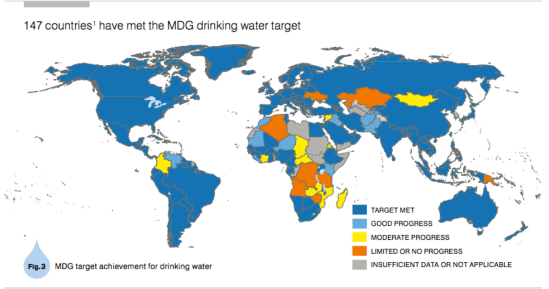
The significant number of deaths and illness caused by waterborne pathogens brings into question the ethics water purification. Christopher Meehan (2013), raises the ethical questions of “Is everyone entitled to be given water no matter where they live? How much water is one entitled to use?”. Answering these can be difficult due to the global disconnect that we have. Meehan, as a Christian, believes that if we have the capability, then we should be doing everything that we can to help out our fellow man. The poorest have little choice and influence, thus it is our moral obligation to help them in ways that we can.
Desalination is a technology that can provide clean water for drinking and other use to communities that are nearby the ocean. The sea water is processed by a reverse osmosis system to remove the salts from the water. A desalination system is capable of providing an endless supply of purified water, however, the cost starting up and maintaining a desalination plant is very high. In David Hazony’s article, How Israel Is Solving the Global Water Crisis (2015), he explains that any national government should be able to afford to implement a desalination plant and that a country’s leaders are to blame if there is a water shortage. Political will and reallocation of the budget will allow for an RO desalination plant to be built. Hazony says, “For the cost of a few fighter jets, you can build a world-class RO plant and pump the water into the system. (2015)
Other ethical concerns appear when companies are faced with getting a product to market in order to make a profit. Both Alexandra Pusateri (2013) and Madeleine Hamrick (2015) give examples of working for large corporations where they were pressured to continue working on water purification products despite the products having significant flaws that could be potentially harmful to the end users.
In Pusateri’s case, she was working on inexpensive RO membranes, made from a new material, that were to be used in a new market in Kenya. She found that the membranes disintegrated after a relatively short period of time and would allow contaminants through the membrane. Despite the pressure from the employer to ship the membranes in a week, she took an ethical stand to stop the distribution.
Hamrick found that the new material that was to be used in the RO membranes was not durable and would need to be replaced frequently. Hamrick said, “If consumers were to forget to replace the membrane, the system could malfunction and compromise the quality of the water that they would be drinking.” (2015) She also had to take an ethical stand against her employer to ensure that a faulty product was stopped.
Conclusion
Reverse osmosis systems are the most efficient way of purifying water. They remove almost all harmful contaminants and allow for clean drinking water all over the world. Despite some concerns about the removal of minerals, RO water is still safer than contaminated water. Ensuring, globally, that everyone has access to clean water should be a strong consideration. Governments should ensure that they are using the latest technology to serve their people. Lastly, Corporations need to ensure that profits are not put ahead of safety. Engineers operate with an ethical code of conduct to put people first.
References
McMahon, J. (2013, November 12). The Dangers of Drinking Water from Reverse Osmosis Systems. Retrieved July 8, 2017, from https://cleanairpurewater.com/home-2/sweetwater-notes/the-dangers-of-reverse-osmosis-wate/
Gerhart, J. (2011, October 25). There’s good and bad to using reverse …. Retrieved July 8, 2017, from http://www.uwhealth.org/news/dr-jacqueline-gerhart-theres-good-and-bad-to-using-reverse-osmosis-water-systems/36710
World Health Organization. (n.d.). 12. health risks from drinking demineralised water. Retrieved July 8, 2017, from http://www.who.int/water_sanitation_health/dwq/nutrientschap12.pdf
Water Benefits Health. (n.d.). Reverse Osmosis Water. Retrieved July 8, 2017, from http://www.waterbenefitshealth.com/reverse-osmosis-water.html
AquaLiv (n.d.). Reverse Osmosis Water Exposed – What They Don’t. Retrieved July 8, 2017, from http://www.aqualiv.com/reverse-osmosis-water-filter-health/
University of Nebraska. (n.d.). Drinking Water Treatment: Reverse Osmosis. Retrieved July 8, 2017, from http://extensionpublications.unl.edu/assets/html/g1490/build/g1490.htm
Water-Right Group. (2016, August 8). Benefits of Drinking Reverse Osmosis Water. Retrieved July 8, 2017, from http://www.water-rightgroup.com/blog/benefits-reverse-osmosis-water/
Pure Earth. (n.d.). Health Effects of Chlorine in Drinking Water. Retrieved July 8, 2017, from http://www.pure-earth.com/chlorine.html
UNICEF. (2015). 2015 Update and MDG Assessment. Retrieved July 8, 2017, from https://data.unicef.org/wp-content/uploads/2015/12/Progress-on-Sanitation-and-Drinking-Water_234.pdf
World Health Organization. (2005). Preventing Traveller’s Diarrhoea: How to Make Drinking Water Safe. Retrieved July 8, 2017, from http://www.who.int/water_sanitation_health/hygiene/envsan/sdwtravel.pdf
World Health Organization. (n.d.). Ensuring safe drinking-water. Retrieved July 8, 2017, from http://www.who.int/entity/phe/events/wha_66/flyer_wsh_water_borne_disease.pdf?ua=1
Meehan, C. (2013). The Ethics of Water – Homiletic & Pastoral Review. Retrieved July 8, 2017, from http://www.hprweb.com/2013/10/the-ethics-of-water/
Hazony, D. (2015). How Israel Is Solving the Global Water Crisis – The Tower. Retrieved July 8, 2017, from http://www.thetower.org/article/how-israel-is-solving-the-global-water-crisis/
Hamrick, M. (2015). Role Of Ethical Conduct In Reverse Osmosis Process. Retrieved July 8, 2017, from http://www.pitt.edu/~mch59/WritingAssignment3.pdf
Pusateri, A. (2013). Ethics And Reverse Osmosis Membrane Technologies. Retrieved July 8, 2017, from http://www.pitt.edu/~amp216/PAPER3FINAL.pdf
 Automation Energy
Leave a comment