
The importance of pure water is ever-increasing. Companies need pure water for their processes and individuals need it for drinking. Municipalities provide access to clean water, however, the water must be further processed to meet the purity specifications of the user. Reverse osmosis (RO) systems are used to convert city water to pure water in an efficient and effective manner of water purification. Osmosis is a simple process, but reversing that process makes it much more complicated. Reverse osmosis, despite the complication, has distinct advantages and disadvantages to other purification methods on the market.
Functions of an RO System
A reverse osmosis system operates by reversing the natural osmosis of concentrated solutions through a semipermeable membrane. In natural osmosis water with a lower concentration of salts will pass through a semipermeable membrane to dilute the water that is concentrated with salts until there is an equilibrium of concentration as shown in

1. To reverse this osmotic process, a pressure is applied to the concentrated side. This further concentrates the solution as the pure water passes through the semipermeable membrane.
Reverse osmosis membranes are somewhat sensitive to certain contaminants and thus require pretreatment to maintain the effectiveness of the membranes. City water is first treated to remove hardness and chlorine. A hard scale can form on the surface of the membrane if the water hardness is too high. The formation of scale will reduce the amount of water from passing through the membrane to the product side. Hardness can be removed with the use of a water softener or an antiscalant that is injected into the incoming water will minimize the effects of water hardness.
The removal of chlorine is very important because of the material used to make the membranes. Long-term chlorine exposure will degrade the membrane material and allow for salt passage through the membrane into the product water. Chlorine can be removed through the use of a carbon filter or chemically with the injection of sodium bisulfite.
After the removal of chlorine and hardness, the water passes through a prefilter to remove solids from the water that could clog up the membranes. Next, the water is fed into a pump that raises the water pressure to the membranes specific pressure for reverse osmosis to occur. Because the pressure against the membranes will vary based on their cleanliness, a throttling valve is used to reduce the pump pressure to the ideal membrane pressure.
The high-pressure water enters the pressure vessel which houses the reverse osmosis membranes. As shown in Figure 2,
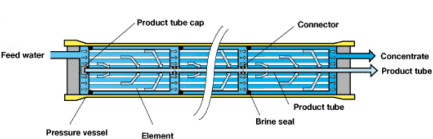
the feedwater entering the pressure vessel is directed into the membrane by the brine seal. Once the water is in the membrane the water flows through mesh spacer to move across the membrane’s surface as shown in Figure 3.Some water passes through the reverse osmosis membrane and accumulates as pure water in the product tube. The concentrated water continues to pass across the surface of the membrane until it exits the vessel in the concentrate tube. The product water exits the vessel in the product tube.
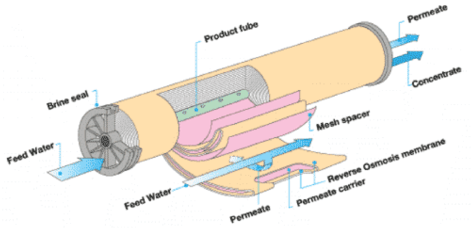
The flows of the product and concentrate are adjusted to get an ideal flow across the membranes. There is a balance between pressing water through the membrane to the product side and moving the concentrated water across the membrane to prevent surface fouling. Product water is maximized and concentrate water is minimized.
Generally, all of the concentrate water goes directly down the drain, however, some systems are equipped with a second reverse osmosis array or a recycling tube. A second array uses the concentrate water again as feed water in a reverse osmosis vessel. This will produce additional product water and further concentrate the concentrated water. Systems with recycling allow some concentrate to return to the feed water to pass through the membranes again. This reduces the amount of water going down the drain while maintaining the flow across the membranes.
The product water from the vessels accumulates and goes to a storage tank. Some systems will use post treatment to raise the water quality to a higher standard and to remove additional permeable contaminants. For example, water that will be used for steam to drive a turbine requires silica to be removed. Silica passes through the reverse osmosis membrane and will be imparted in the steam thus causing damage to the turbine blades. Silica is removed by passing the product water through a deionization vessel.
Deionization is a common post-treatment of water because it raises the water quality by removing water conductivity. The water quality, of pure water, is measured using resistivity. Water with a higher resistivity is purer. Water can be polished by deionization up to 18.2 Megohms.
Because the chlorine is removed from the water prior to it entering the reverse osmosis system, the water can harbor bacteria. Some systems will inject chlorine as a post treatment to kill bacteria, while other systems use UV sterilization. Water sitting in a tank can grow bacteria, so water should be recirculated with a recirculation pump. The pump can pass the water through the UV sterilizer and pressurize a system to provide water at the points of use.
RO System Advantages and Disadvantages
When “compared with other conventional water treatment processes, reverse osmosis has proven to be the most efficient means of removing salts, chemical contaminants and heavy metals” (“About Reverse Osmosis”, n.d., para. 7). The efficiency of an RO system is measured in two ways: rejection and recovery. Rejection is the measure of salts removed from the water by use of a conductivity measurement both before and after reverse osmosis. A properly operating RO system will typically remove 95-99% of conductive contaminants. The recovery is the volume of water that passes through to the product side as compared with the total feed water entering the RO system. The recovery rate can vary widely between different system configurations from 40-80%.
In the event that a reverse osmosis system stops working, the individual components of the system can be repair or replaced to get the system back online. These systems require periodic maintenance to keep them running at peak efficiency. Pretreatment options need to be regenerated, refilled, or replaced on a scheduled basis. The membrane pressure, concentrate flow, recycle flow, and product flow needs to be adjusted on a periodic basis to ensure the water recovery is being maximized as the membranes become dirtier. As the efficiency of the membranes drops, the membranes need to be cleaned. The membranes can be cleaned in place by recirculating cleaning chemicals while the system is offline or by removing them and cleaning them off site.
“Since there is no chlorine present on the membranes, microorganisms can grow with an enhanced nutrient offering, unless the system is sanitized very frequently” (Water Chemistry and Pretreatment, n.d., para. 5). The buildup of microorganisms creates a biofouling which reduces the efficiency of the RO system. Sanitization can be costly due to labor, chemicals, and downtime. Sterilant is put into the RO system and recirculated through the membranes for a specified contact time to eliminate microorganisms.
Another disadvantage of an RO system is based on the amount of recovery that an RO system has. There is always wastewater produced with the RO system. Some companies are restricted by municipal discharge limits and others are restricted by the cost of water. Water waste can be very expensive which could lead the user to choose a different option that does not produce waste water.
A reverse osmosis system has a high initial cost for the system and its installation. The maintenance fees add on to this cost as well. However, when compared to an exchangeable deionization system, the RO system has a lower long-term operating cost. The RO system does not require access to frequently move deionization tanks in and out and produces a constant quality of water on demand.
Conclusion
Reverse osmosis systems bring a great level of value to the user by providing a nearly endless supply of pure water. Despite being a large investment upfront, all of the components that make the process work are repairable or replaceable. The infrequent routine maintenance allows the system to run on its own for long periods of time without disruption in the water supply or by maintenance personnel. Because of these key advantages, an RO system is the premiere choice for pure water production.
References
(n.d.). About Reverse Osmosis What Is Reverse Osmosis Ro | Applied Membranes Inc. Retrieved June 17, 2017, from http://www.appliedmembranes.com/media/wysiwyg/pdf/systems/about_reverse_osmosis_what_is_reverse_osmosis_ro.pdf
(n.d.). What is Reverse Osmosis? | Puretec Industrial Water. Retrieved June 17, 2017, from http://puretecwater.com/reverse-osmosis/what-is-reverse-osmosis
(n.d.). Features Of Reverse Osmosis – Toray Membrane. Retrieved June 17, 2017, from http://www.toraywater.com/knowledge/kno_001_02.html
(n.d.). Water Chemistry and Pretreatment – The DOW Chemical Company. Retrieved June 17, 2017, from http://www.dow.com/webapps/lit/litorder.asp?filepath=liquidseps/pdfs/noreg/609-02034.pdf&pdf=true
(n.d.). Understanding Silica Removal by Ion Exchange – The DOW Chemical Company. Retrieved June 17, 2017, from http://www.dow.com/scripts/litorder.asp?filepath=liquidseps/pdfs/noreg/177-01764.pdf
(n.d.). Factors Affecting Perf. – Water Treatment Guide. Retrieved June 17, 2017, from http://www.watertreatmentguide.com/factors_affecting_membrane_performance.htm
 Automation Energy
Leave a comment